
Texans can expect preliminary midterm election results to begin rolling out shortly after polls close tonight at 7 p.m., offering a first glimpse into who may be their next local, state and federal leaders.
The first waves of results will be based on ballots cast during the early voting period, which typically accounts for a large portion of overall votes. Throughout the evening and into early Wednesday, election officials across the state will post rounds of unofficial results.
It will take much longer before official results are released because election officials have to consolidate ballots and follow a lengthy list of procedures to ensure votes are counted accurately.
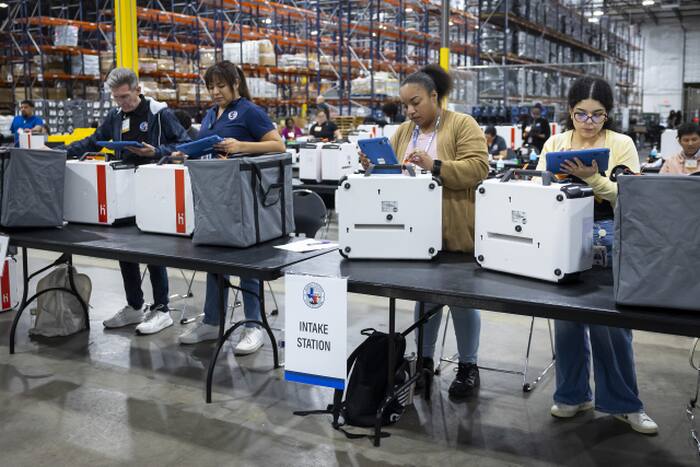
Tens of thousands of ballots in the state’s largest counties will begin funneling in from hundreds of voting locations to county election offices. Some large counties will have designated substations where election workers can drop off materials to get the voting counting started, but most counties gather all ballots in one location before doing so.
To get a head start on reporting results, election officials in counties with a population of more than 100,000 can begin counting received mail-in ballots after polls close on the last day of early voting. Smaller counties are allowed to start counting the morning of Election Day.
Once vote counting has begun, it cannot stop until completed. State law requires Election Day totals to be submitted to the state within 24 hours after polls close.
After results from polling locations make their way to the central counting stations, election officials submit the numbers to the state. Election workers manually enter totals for every race into the statewide election management system. The secretary of state’s office then reviews county reports to ensure the information is correct before unofficial election night results are finalized.
Election officials can begin counting votes cast on Election Day only after polls close and voting has ended.
That timetable can be slowed because state law requires polling locations to remain open until everybody in line at 7 p.m. casts a ballot. Another factor to consider: the El Paso area is on Mountain Time, putting it an hour behind most of Texas.
Once all ballots are cast at a voting location, supervisors must follow a series of security measures. Before leaving the polling location, they must fill out paperwork detailing the number of ballots counted by ballot scanning machines and the number of voters who checked in to vote. Then they pack up all ballots, paperwork and voting equipment and take them to the county’s central counting station to be tallied.
In large counties, getting ballots and equipment back to the main counting station can take more time and delay the election results. For example, in Harris County, the third most populous county in the country, some election results come in from polling sites more than a 45-minute drive from the county election headquarters. To speed up the process, Harris and other large counties have more than one counting station where election workers can drop off materials to get the vote counting started.
Once election workers turn everything in, county election administrators review and verify the information from each polling site, and counties must post the comparison of the number of voters and the number of ballots cast on their election websites.
The deadline for election officials to receive mail-in ballots sent within the U.S. is Nov. 4, and the deadline for mail-in ballots sent from overseas is Nov. 9. All mail-in ballots must have been sent before 7 p.m. on Nov. 3.
The deadline officials to review provisional ballots — ballots offered to voters whose eligibility is uncertain — is Nov. 13.
In Texas, only an exact tie automatically triggers a recount.
A losing candidate can request a recount only if they lost by 10% or less of the total votes cast in their race. They also have to pay for the recount, with the cost depending on how votes are collected within their district.
If the precinct or polling location uses electronic voting systems, the candidate seeking the recount must deposit $100 for each precinct or polling location on Election Day (whichever is fewer). For locations with regular paper ballots, it’s $60 for each precinct or polling location.
Whether the votes are recounted by hand, retabulated or electronically reviewed, the full costs of the recount are assessed against the candidate requesting the recount — unless the recount changes the outcome of the election.
If the outcome changes, the deposit is refunded.
“It is very rare for recounts to come back with a different outcome than the issued results,” said Kevin Johnson, executive director of Election Reformers Network, a nonpartisan nonprofit focused on ensuring that U.S. elections are run impartially.
He added that some states have recounted millions of ballots, and even for races determined by small margins, results didn’t change. “There have been incidents of recounts changing results, so it’s not right to say it never happens, but that’s very rare.”
Texas’ requirements for an automatic recount are strict compared to other states, said Jonathan Diaz, director of voting advocacy and partnerships at the nonpartisan Campaign Legal Center.
Only five other states limit automatic recounts to exact ties — Alaska, Maine, Montana, South Dakota and Utah.
Most states have an automatic recount process that is triggered if a race is determined by a small margin. The most common is 0.5%, Diaz said.
Although victors will be declared tonight and early Wednesday, results are not official until they’re certified under a state-mandated process involving the governor, House speaker and county commissioners.
Local canvassing authorities — typically a county commissioners court — certify local elections, such as races for city council and mayor.
For state and congressional races, Secretary of State Robert Howden will tabulate and verify election results, after which Gov. Greg Abbott issues a “certificate of election” to the winners. Races for governor and lieutenant governor, however, will be certified by House Speaker Dustin Burrows, R-Lubbock, on Jan. 12, the first day of the 2027 legislative session.
This typically noncontroversial and quick step typically comes weeks after Election Day and involves verifying that results were accurately tabulated and reported.
Certifying the results is a legal responsibility set out in the Texas Election Code, which says public officials “shall certify the tabulations.”
Joshua Blank, research director of the Texas Politics Project at the University of Texas at Austin, pointed out: “It’s not a ‘may,” it’s a ‘shall.’ It’s an obligation.”
Disclosure: The University of Texas at Austin has been a major financial supporter of The Texas Tribune. The Texas Tribune is a nonprofit, nonpartisan news organization that is funded in part by donations from members, foundations and corporate sponsors. Financial supporters play no role in our journalism. Find a complete list of them and more information about our financial and disclosure policies here.


