

With the Apple Watch Series 12 and Ultra 4, Apple introduced a new health-sensing system. The new energy-efficient LED sensors measure heart rate every five seconds. Heart rate variability is also measured significantly more frequently than before. Macwelt was able to verify this in our review of the Apple Watch Series 12. The watch now measures your pulse every five seconds even when you’re not exercising, and heart rate variability is now recorded every five minutes. The battery still lasts for 24 hours.
This is exciting, because the Apple Watch already had stellar heart-rate tracking. How often and how accurately has the Apple Watch been measuring key health parameters to date? Apple hides the answers to these questions in its support documents. For some measurements, there are no official figures at all. So we took a closer look using the Apple Watch Series 11, which has the same third-gen optical heart rate sensor that was introduced with the Apple Watch Series 6.
The answer to this question depends on the situation and the settings on your Apple Watch. In workout mode, the Apple Watch measures your heart rate every five seconds. The watch also measures your heart rate at this high frequency for the first three minutes after your workout. However, there is also a special setting for long workouts, where the user can activate power-saving mode if required. Apple claims that measurements are taken less frequently in this mode. I recorded a HIIT workout using the Polar H10 chest strap as a reference device. I also started the same workout on the Apple Watch Series 11.
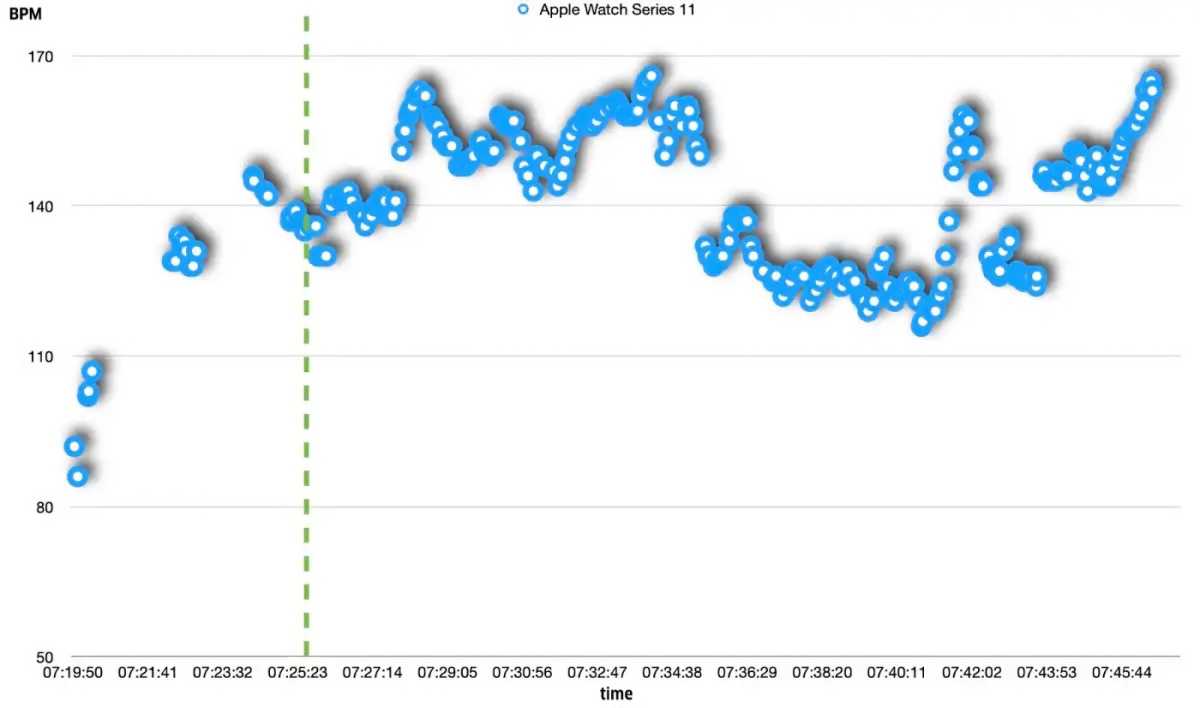
Heart rate measurement on the Apple Watch Series 11 during a workout.
Foundry
The Apple Watch actually measures heart rate every five seconds while the wearer is exercising. Measurements in power-saving mode during a workout also take place every five seconds. However, the system pauses the measurement for several minutes. This means that the heart rate is measured in short intervals every 5 seconds, then the Apple Watch pauses. You can see this on the graph of the heart rates measured during the workout up to the green line: up to that point, the Apple Watch was running in power-saving mode; after that, I switched it off.
Speaking of power-saving mode. If this mode is activated all the time, no background measurements take place, neither of the heart rate nor of heart rate variability. Furthermore, the vital signs data following a recorded night’s sleep lacks the oxygen saturation readings from during the night.
The Apple Watch can also measure your heart rate every second, just like chest straps do during a workout. However, these measurements only occur sporadically: during user-initiated ECG readings and during background HRV measurements. When you launch the ECG app and place your finger on the Digital Crown, the animation on the Watch and the PDF generated afterwards show the heart rate readings for every second. During HRV measurement, too, the Apple Watch records each heart rate over the course of a minute and then uses a specific formula to calculate the time interval between individual heartbeats.
In the background, and particularly at night while you’re asleep, the Apple Watch measures your heart rate every five minutes. However, the measurements aren’t as regular as they are during exercise. The intervals can vary more significantly when you’re at rest.
I exported and analysed measurements from a sample night using the Health app. For the sake of clarity, the chart above shows only one hour. During six and a half hours of sleep, the Apple Watch took 83 measurements. The average interval between measurements here is 4 minutes 39 seconds, although gaps of 16 minutes or as little as 40 seconds are also possible.
When unveiling the Apple Watch Series 12, Apple claimed that the new smartwatch was the most accurate heart rate fitness tracker on the market. While we can only verify this claim through a single test, older models show that the Apple Watch was already quite accurate when it came to heart rate measurement.
When we tested the Apple Watch Ultra 3, we found that the Ultra’s readings deviated only very slightly from those of the chest strap. I analysed the same HIIT workout described above using the Apple Watch Series 11. The following picture emerges from the progression of the two graphs. On average, the Apple Watch measures your heart rate quite accurately during exercise.
The correlation coefficient between the two measurements–from the Polar H10 and the Apple Watch Series 11–is 0.95. This means the Apple Watch measures quite closely to a chest strap. On average, the two readings differ by just one beat. However, there are outliers: the higher the heart rate, the less accurate the measurement becomes. This can be seen in the line showing heart rates of 160 beats per minute and above. The measurement is also rather inaccurate in power-saving mode, as the Apple Watch can completely miss heart rate spikes due to the sporadic mode.
The new features Apple announced for the Apple Watch Series 12 and Ultra 4 are exciting because they effectively turn the entire heart rate measurement algorithm on its head.


